A history written in leather and canvas since 1905.
The founding of Vasco & Gama at Rua do Carmo, 75, was not merely the opening of a workshop. It was the beginning of a commitment. As our founder used to say: "A piece that tears is a broken promise." For over a century, we have honored this promise.
We refuse mass industrialization. We operate in a dimension where time is the most valuable resource. From the hands of our apprentices to the tools of our Masters, every cut and every stitch requires absolute focus. We do not follow trends; we create objects that stand the test of time and elements.
Brand Chronology
1905
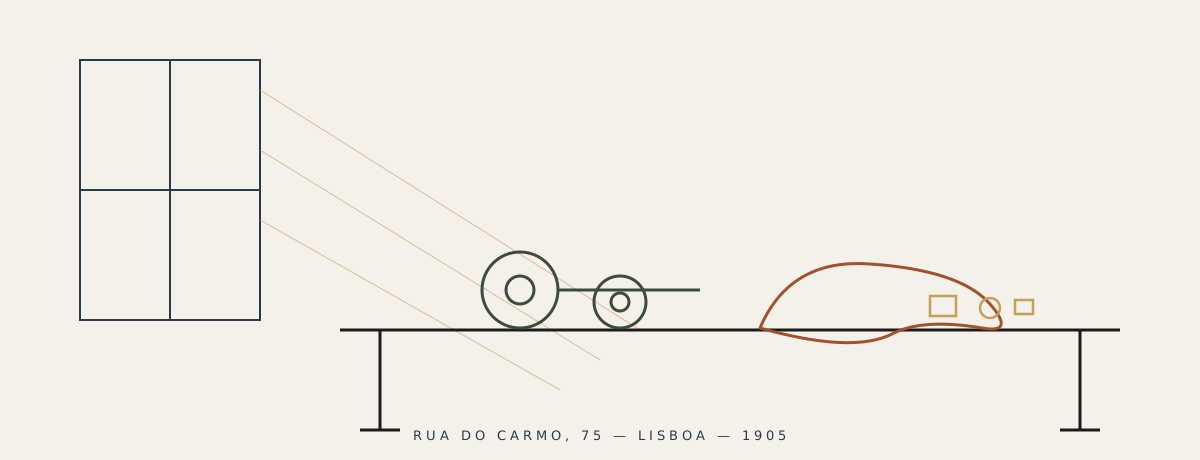
Workshop opened at Rua do Carmo, 75, Lisbon. ~26 m². Cutting table, Singer treadle sewing machine, leather rack from Bairro Alto. Waxed canvas with Aveiro wax, vegetable-tanned leather from Tejo, home-spun hemp thread. Every seam is double, every reinforcement is triple. Founder: "A piece that tears is a broken promise."
1906
First apprentice hired: a 14-year-old boy from Madragoa, future son-in-law and successor.
1907
Expansion into adjacent space, doubling the production capacity.
1908
First sales outside Lisbon (Porto, Coimbra) via railway intermediaries.
1909
Informal registration of the name "Vasco & Gama" on a business card printed by Ferreira typography, Rua Augusta.
1910
Proclamation of the Republic. He sews a republican flag on a piece of canvas on the night of October 5, not out of political conviction, but out of loyalty to the customers sheltering in the workshop.
1911–1920
Organic growth. Three proprietary techniques developed (still family secrets today): three-layer canvas waxing, leather corner reinforcement with cross-stitching, seam sealing with pine resin. Transmitted orally, without written record.
1912
Expansion into wallets and handbags for the Lisbon bourgeoisie.
1915
Acquisition of land in Bairro Alto for an own tannery, avoiding chrome-based chemicals.
1918
Production of medical cases for the Portuguese Expeditionary Corps in the Great War.
1920
Marriage of the oldest daughter to the 1906 apprentice, formalizing transmission to the second generation.
1923
First mention in the press (newspaper "O Século").
1925
First export (Brazil, African colonies).
1938
Official transmission to the second generation. Introduction of solid brass hardware (replacing iron, which rusted due to marine humidity).
1940
Participation in the Exhibition of the Portuguese World, Lisbon. Praise from the President of the Republic.
1947
Lisbon Industrial Fair. First prize for craft excellence.
1955
Golden Jubilee. Launch of the first line of travel bags structured with an internal frame of Portuguese cork oak wood, reducing weight by 30% without losing rigidity.
1957
First international exhibition: Barcelona Craft Fair.
1962
Second workshop in Porto: leather belts and accessories. 12 masters, 8 apprentices.
1965
International Leather and Goods Salon, Paris. Bronze Medal (men's travel accessories).
1972
Copenhagen Design Fair. Functional Design Award (internal structuring of bags).
1974
Political transition in Portugal. Refusal of mass industrialization and persistence of manual labor.
1985
Introduction of high-density ballistic nylon in high-wear areas of backpacks.
1989
Leather Salon, Lyon. Craft Master Diploma from the National Syndicate of French Leather Goods.
1998
Expo 98, Lisbon. Exhibition on the evolution of Portuguese leather goods in the 20th century.
2005
Centennial. Limited edition of 100 numbered pieces, with laser-engraved brass plates.
2011
CE, UKCA, FCC certifications.
2015
Reykjavík Craft Summit. Resistance and Durability Award (arctic tests).
2017
Operational peak: 2 workshops + 1 factory, 837 m² of production area, 441 specialists and masters.
2018
Oslo Design Week. Men's Elegance Award.
2019
Authenticity card system with hologram (response to Asian replicas).
2020–2022
Pandemic. Production reduced by 70%, 2/3 of masters laid off, reduced shifts, family financial reserves mobilized.
2021
Bergen Handverksmesse. Special Mention (craft techniques on a family scale).
2023
Gradual recovery.
2024
80% of pre-pandemic capacity. Digital domain registration, start of verification platform design.
2025
Full recovery of production volumes to the peak 2017 levels.
2026
Launch of the digital platform on the 121st anniversary of the brand.
International Recognitions
PORTUGAL — Lisbon Industrial Fair (1947): Craft Excellence Award.
PORTUGAL — Expo 98 (1998): Honorable Mention (preservation of traditional leather goods).
FRANCE — International Leather Salon, Paris (1965): Bronze Medal (men's travel accessories).
FRANCE — Leather Salon, Lyon (1989): Craft Master Diploma.
DENMARK — Copenhagen Design Fair (1972): Functional Design Award.
DENMARK — Formland Fair, Herning (2005): Sustainability Award.
ICELAND — Reykjavík Craft Summit (2015): Resistance and Durability Award (arctic tests).
NORWAY — Oslo Design Week (2018): Men's Elegance Award.
NORWAY — Bergen Handverksmesse (2021): Special Mention (craft techniques on a family scale).